History
Click here for a video tour of St. John's history and buildings.
Jump to:
- The Colony of Virginia
- Building St. John's
- Plague and War
- A New Space for the 20th Century
- Ministry in a post-Christian world
 The Colony of Virginia
In 1607, colonists, sent from England, paused on their way into the Chesapeake Bay for fresh water and a view of their new land. The Reverend Robert Hunt, Anglican priest for the settlers, planted a cross into a sand dune near Cape Henry, proclaiming England’s unique brand of Christianity as the official faith of the new colony. Then the settlers moved on to establish the Jamestown colony, and The Church of England (Episcopal Church) would remain the established church of Virginia for the next 172 years.
On the west bank of the Elizabeth River, the land that would become Portsmouth was identified in 1620 as a prime location for shipbuilding. Colonel William Crawford, a ship owner and wealthy mercha nt, planned the town of Portsmouth in 1750. Crawford dedicated a square in the new town for a church, and Portsmouth Parish (now Trinity Church) was erected in 1762. The Gosport Shipyard (now Norfolk Naval Shipyard) was founded in 1767, and Portsmouth continues to support the Navy and Coast Guard today.
Building St. John's
In July 1845, seven vestry members of Trinity Church, joined by other members of that colonial parish, began a movement that would lead to the formation of St. John’s Church. These members disagreed with new ideas from the Oxford movement being taught by Trinity's rector, principally: 1) that a person’s baptism was not valid unless it was performed by a priest who had been ordained by a bishop; and 2) that the decisons of the priest were absolute and could not be questioned by the members of the congregation.
At the 1848 Diocesan Annual Council meeting, Bishop William Meade and the Diocesan Council approved a petition to form this new church to be called St. John's.
 The first worship space was completed in 1850 and was located at the corner of Court and London Streets (the site now holds a parking lot for Court Street Baptist Church). That same year the congregation called the Rev'd James Chisholm to be their first rector.
Plague and War
 An aggressive epidemic of Yellow Fever ravaged Portsmouth in 1855, causing many of the wealthy residents—including physicians and clergy—to flee. This left many citizens of Portsmouth without medical care, even without food and clean water. The Reverend James Chisholm, first rector of St. John's, sent his sons away (his wife having died 7 months earlier) but remained in Portsmouth to care for the poor and the sick. Exhausted by his efforts, Chisholm contracted Yellow Fever and died in the Portsmouth Naval Hospital. He is buried in nearby Cedar Grove Cemetery.

A wall monument dedicated to James Chisholm is one of the three items from the original 1850 church building that was moved into our current worship space. The Episcopal Church has recognized Chisholm's selfless example by adding him to the calendar of saints we celebrate each year.
During the Civil War, Portsmouth was occupied by the Union army. At that time, the rector, after escorting his family to Fredericksburg for safety, was unable to travel through army lines to return to Portsmouth. In 1863, General Barnes took control of St. John's as a place of worship for United States soldiers. When the war ended, the parishioners of St. John's returned to their church home.
 As was custom at the time, the pews in the original church building were like tiny rooms that each had a door with a bolt. Also customary at the time, the parishioners rented or purchased their pews. In 1868, St. John's struggled to pay its expenses. Their new rector, the Rev'd John Powell, proposed a novel idea that was taking hold in Anglican parishes in England and in the United States: free pews. Instead of supporting the mission of St. John's by renting pews, members contributed to the parish from their income, using pledge envelopes. In this difficult time of post-Civil War Reconstruction, Powell agreed to accept the reminder of the offerings after all the expenses of the church had been met and refused Diocesan assistance since this would change the status of the church to a mission. This saintly man served faithfully until 1895. A wall monument remembering his ministry hangs across the nave from Chisholm's. The cruciform brass sign still proclaims today, to all all who enter St. John's, “All Seats Free”.
A New Space for the 20th Century
 In 1897, St. John's applied for a building permit, to construct the current church building at the corner of London and Washington Streets. Built with rose granite from Salisbury, North Carolina, the church was estimated to cost $25,000—adjusting for inflation, that is about $645,000 in today's dollars. This worship space dwells between the magnificent rose window and the glorious Tiffany window that depicts Jesus with his hands outstretched in welcome.
The adjacent parish house—home to our parish hall, meeting rooms, and Christian Formation spaces—was built in 1915 and expanded in the 1950s. Early in the century the parish hall was a social center of the community, hosting many memorable entertainment and dining extravaganzas. Today, a number of groups use this space for community meetings, twelve-step recovery groups, and bible study. Each winter, the parish house is transformed into a safe space for homeless persons in Portsmouth to join in a hot meal and a warm place to sleep; parish volunteers find themselves transformed by observing the commands of Jesus to feed the hungry, to house the traveler, and to love all persons as Christ loves us.
St. John's was blessed with and well served by a number of distinguished clergy, two of whom would later become bishops. The Rev'd William A. Brown was rector from 1903-1938 when he was elected Bishop of Southern Virginia. The Rev'd C. Cabell Tennis, who served as Assistant Rector from 1964-1965 and caused quite an uproar for his work with the Civil Rights movement, would later become Bishop of Delaware.
Ministry in a post-Christian world
At the eve of the millenium, the vestry realized that the parish stood at a crossroads: it could engage the rapidly changing world or face the prospect of becoming a museum. The parish boldly made the decision to engage the future. Calling the Rev'd Ronald Greiser (rector 1999-2010), the parish began a number of new evangelistic initiatives including the complete renovation of the worship space and parish house, creation of small group ministries and the creation of the 9am Contemporary Eucharist. During Fr. Greiser's tenure, St. John's also called its first black priest, Fr. Esau McCauley, as Assistant Rector.
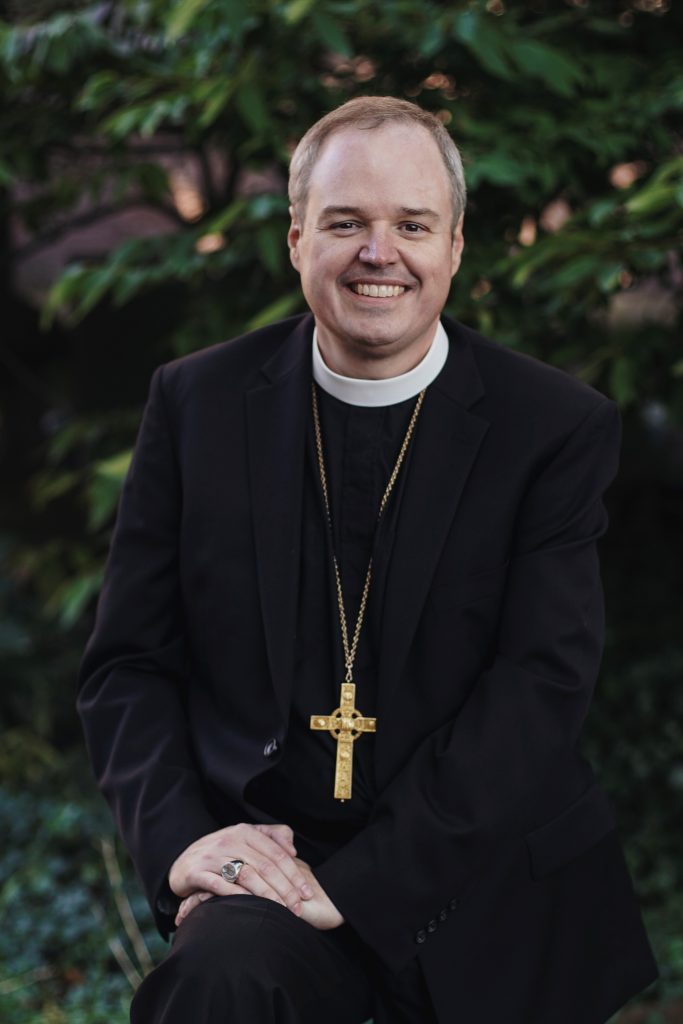
 Our current rector, the Rev'd Dr. J. Derek Harbin, came to St. John's in January of 2011. Fr. Derek is keenly committed to Jesus Christ. He is a person of integrity who works to live the Gospel and brings expertise in the field of congregational development, particularly in the area of connecting the riches of our tradition with the culture. In addition to his work as an adjunct faculty member in a seminary doctoral program in congregational development, he has provided productive and fruitful leadership to congregations of every ministry size—resource, program, transitional, pastoral, family—as well as led a church plant through two size transitions. His spiritual passions and gifts lie in the areas of inspiring people towards a vision, teaching, preaching, liturgy, administration and care for ordained and lay ministry leaders. Partnering with Fr. Derek in this ministry is Associate to the Rector--Clifford King Harbin--who is a seminary graduate, former church planting pastor, and experienced lay professional in the church who is also a National Formation Leader for the Catechesis of the Good Shepherd and a national trainer for the Catechumenal Process.
Housed in a glorious worship space in a historic neighborhood, blocks from the lovely Elizabeth River, the dynamic people of St. John's are excited about the blank page of the future we have yet to write. How will we follow Jesus as we move into the neighborhood to dwell among the people of this community? How will the Holy Spirit inform our hearts and minds on the spiritual journey before us? Who can we invite to join in the great feast? How will we shine God's light into the world, giving hope and comfort to all persons? Come and see!